
Exploring the Cape Peninsula – Cape of Good Hope, Cape Point, Simon’s Town and Wildlife
There’s something about the Cape of Good Hope that makes you feel like you’re truly at the edge of the world – rugged cliffs, merging ocean waters, sweeping ocean views, and the beauty of nature all put together in one place.
An Early Start & Scenic Drive along Chapman’s Peak Drive, Atlantic Coast, Penguins, Ostrich Farm
We set out early from Cape Town, driving south along the Cape Peninsula, one of the most scenic stretches of road you will find anywhere. Just a few minutes into the drive, we entered the mountain region, driving high up with views of the Atlantic Ocean to our right. As we approached Chapman’s Peak Drive, the clouds lingered, casting a soft, misty light over the cliffs. Chapman’s Peak Drive is a 9 km stretch offering

Blue Planet Travellers
View of Hout Bay from Chapman’s Peak drive
absolutely stunning views of the ocean below, and it was truly breathtaking. We were there in mid August and the day started cloudy but it didn’t rain and got sunny as the day passed.
We then headed to Simon’s Town our first stop. You can see my blog post on Simon’s Town – Boulders Beach to visit the penguins here.

Blue Planet Travellers
Bonteboks
After that, we continued driving along the Cape Peninsula towards the Cape of Good Hope. There were several scenic spots along the way where we stopped to take in the views and capture photos. We saw some bonteboks grazing all over the fields along the route.
Later, we stopped at the Cape Point Ostrich Farm, located in one of the most beautiful parts of the Cape Peninsula, very close to the Cape of Good Hope Nature Reserve. They had several ostriches that we were able to see up close. They are truly huge, being the world’s largest birds. Cape Point Ostrich Farm is also a productive breeding farm. With beautiful mountains on one side and green meadows surrounding it,

Blue Planet Travellers
Cape Point Ostrich Farm
the farm created a wonderful atmosphere. We spent about half an hour there walking around and observing the ostriches.
We then continued our journey, and within 10 minutes we reached the Cape of Good Hope Nature Reserve, which is part of the larger Table Mountain National Park. The Cape of Good Hope lies within this reserve.
Journey to the Cape of Good Hope

Blue Planet Travellers
Cape of Good Hope and the Atlantic Ocean behind
As soon as we entered the reserve, we were able to see the iconic wooden sign that says Cape of Good Hope, The Most South Western Point of the African Continent. There is a great feel to it, with the view around and really feeling like you are at one of the edges of the world. Though at Cape of Good Hope, both the Atlantic and the Indian Ocean currents mix, and the waters of both these oceans merge here. Officially, Cape of Good
Cape of Good Hope is considered to be along the Atlantic coast. Due to the strong currents from the merging waters of the Atlantic and Indian Oceans, the Cape of Good Hope is known as the Graveyard of Ships. It has caused over a thousand shipwrecks, making it a dangerous route for sailors.

Blue Planet Travellers
At the Cape of Good Hope
It is often misunderstood that Cape of Good Hope is where both the Atlantic and Indian Oceans meet, while the true meeting point is at Cape Agulhas. There are some pictures seen online showing a clear divide of these oceans at Cape Agulhas. What we heard from tour guides is that in reality, we cannot see such
a divide of the oceans, and they are not sure if anyone used any special lens to capture it. The merging of waters happens over about an 80 km range and is not along a single visible line.
We spent some time enjoying this beautiful view. We waited in line to take some pictures with the iconic wooden sign, with the backdrop of the Atlantic Ocean. The fierce ocean waves crashing against the rocks on the shore were an absolute delight to our eyes.
Hiking Toward Cape Point – Old Lighthouse from Cape of Good Hope
We decided to hike from there and continued our journey toward Cape Point. You can follow the paths that run along the cliffs and lead up toward Cape Point (Cape Point Sign board) and the lighthouse. Hiking here was a great choice as we were surrounded by dramatic views in every direction. Although there were several lookout spots, every part of the trail felt surreal. Whether you choose to walk straight through or explore slowly and stop for photos along the way, the views continue to reward you.

Blue Planet Travellers
The View of Dias Beach and Cape of Good Hope from the trail
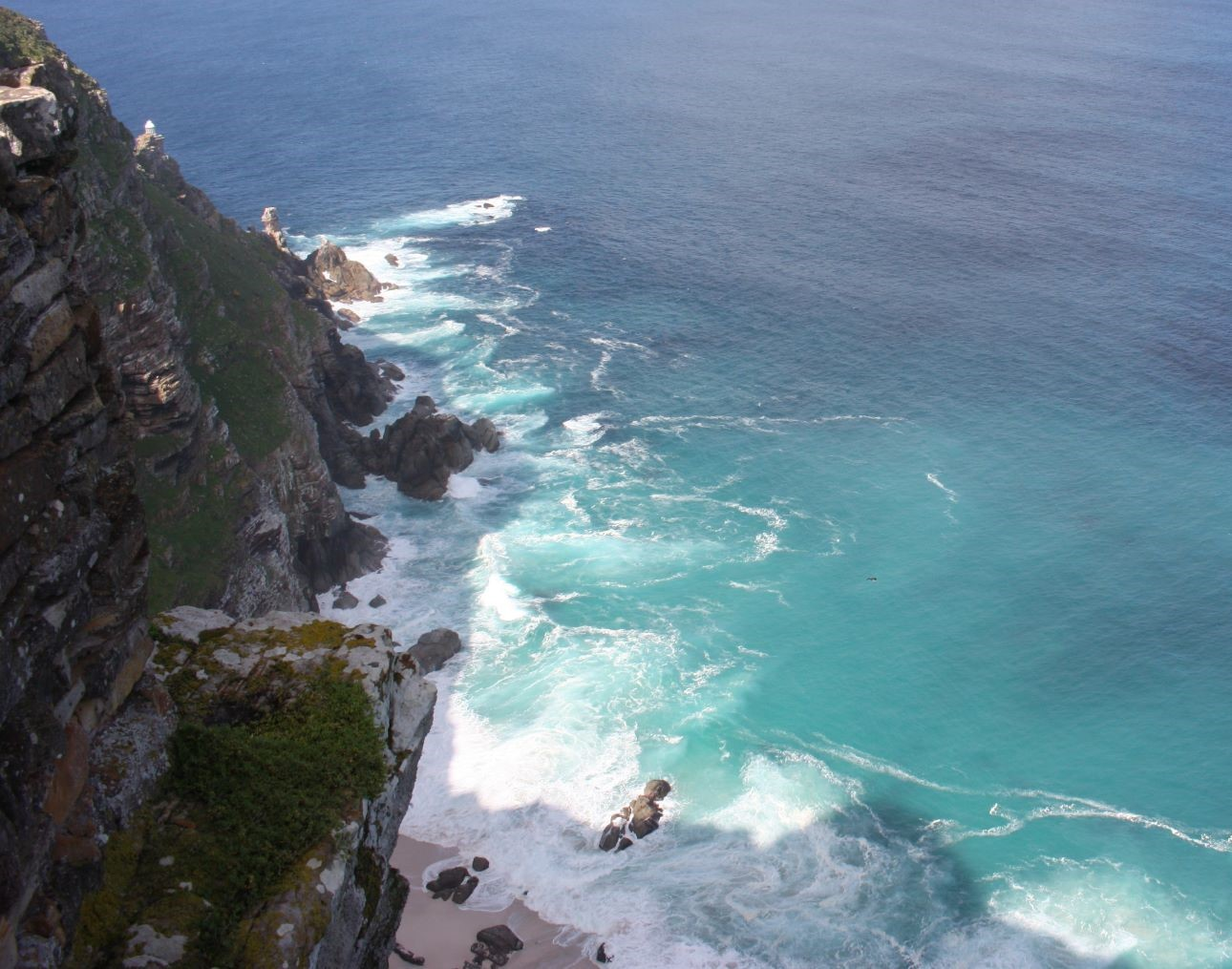
At the top, the rocky coastline curves back toward False Bay, offering views of Dias Beach, the Cape of Good Hope, and the endless ocean beyond. We reached Cape Point in about forty five minutes. We stopped here to enjoy the views and take photos.

Blue Planet Travellers
Cape Point and the view of the old lighthouse above

Blue Planet Travellers
View from Cape Point Trail- the new lighthouse at the tip of the Cape Penninsula
Hiking to the Old Lighthouse from Cape Point Sign

Blue Planet Travellers
Stairs that lead to the old Lighthouse
There are two lighthouses at Cape Point, the old lighthouse and the new lighthouse. The old lighthouse sits at the top, while the new one is far below. Walking to the old lighthouse is one of the highlights of visiting the Cape Point Peninsula. From Cape Point, We hiked about 20 minutes and then we climbed a series of staircases with more than one hundred steps. It was August and quite hot, but the cool ocean breeze kept us energized.
Once we reached the top, we arrived at the old lighthouse. The view was spectacular, with cascading mountains meeting the ocean and fading one behind the other. The combination of ocean views, dramatic cliffs, and beaches naturally creates a scenic landscape that should not be missed.

Blue Planet Travellers
Tip of the Penninsula from the old Lighthouse

Blue Planet Travellers
View from the top – at the old lighthouse
The lighthouse sits at the very edge of the peninsula, overlooking the vast ocean below.Near the end of the peninsula, there is a final viewpoint from where we could see the new lighthouse. Unfortunately, it is not possible to reach the new lighthouse as there is no trail leading there, and it sits on a steep cliff. Seeing the new lighthouse perched at the tip of the Cape Peninsula far below was truly magnificent.
Where We Stayed: Camps Bay
We chose to stay in Camps Bay, and honestly, we couldn’t have picked a better spot. Whether you stay in a hotel or a guesthouse, you’re almost always guaranteed stunning ocean views.
We stayed at 3 On Camps Bay in Camps Bay, Cape Town. The location close to the beach which made it easy to enjoy the ocean views and local cafés, and it was the perfect base for both relaxing and exploring the city.
If this hotel is fully booked or not the right fit, you can also check other hotels in Camps Bay to find something that suits your travel style and budget.
Prices can change quickly depending on season and dates, so it’s worth checking availability for your travel plans.
Tours We Recommend in Cape Town
Make the most of your Cape Town adventure with these unforgettable experiences:
- Table Mountain Hike or Cable Car Experience
See Cape Town from above with a scenic hike or the cable car, offering panoramic views of the city, beaches, and harbor.- Cape Peninsula & Cape Point Tour
Drive along the breathtaking Chapman’s Peak, visit Cape Point, and enjoy stunning ocean views along the peninsula.- Simon’s Town & Boulders Beach Penguins
Meet the charming African penguins up close at Boulders Beach and explore the historic seaside town of Simon’s Town.- Optional Wine & Winelands Tours
Combine a half-day trip to nearby Stellenbosch or Constantia for wine tasting and local cuisine.These tours can easily be added to your 4-day Cape Town itinerary or enjoyed as stand-alone experiences.
Tips and FAQ
Reaching Cape Point and the Old Lighthouse
The Cape of Good Hope is located at the car park level close to the ocean and does not require a hike. This is where the Cape of Good Hope sign is.
Cape Point is the referred to as the entire region above the Cape of Good Hope at the Southern end of the Cape Penninsula. This includes the beautiful trail, the Cape Point sign and the old and new lighthouse. Reaching Cape Point sign requires a hike from the car park.
There are two ways to reach the old lighthouse, you can take the Flying Dutchman funicular to the top and then climb a few steps to reach the old lighthouse viewing area, or you can hike about forty-five minutes from the Cape of Good Hope to Cape Point. Then continue hiking for another twenty minutes before reaching a staircase. From there you climb over some 100 steps, plus the final few steps, to reach the old lighthouse viewing area.
Water and Food Availability
There is a restaurant at the car park where you can find good sandwiches and pizza. If you plan to hike, this is the best place to get water, as there are no other water sources along the trail or on the return journey.
Best time to visit Cape Penninsula
The best time to visit Cape of Good Hope and Cape Point is during September – November. This is when the weather is pleasant for hiking.
Leave a Reply