
Two Days Journey to Machu Picchu – Family Travel Guide, Tips and FAQ
Visiting Machu Picchu had been on our family travel list for a long time. Traveling with a child always means planning a little extra, slowing down a little more, and experiencing places in a different way. For these two days, we were excited not only to see one of the seven wonders of the world, but also to experience it together as a family, learning some history, enjoying the mountains, the train ride, and every small moment along our journey.
Our goal for these two days was to explore Machu Picchu citadel, and enjoy the Andean beauty with its fiercely tall peaks. Even though we had seen pictures of Machu Picchu so many times, but nothing prepared us for how it actually felt standing there surrounded by the Andes.
Where We Stayed
Ollantaytambo
El Albergue Ollantaytambo hotel was just inside the Ollantaytambo train station complex. The train stopped right in front of the hotel. The hotel had its own organic farm. At night, one of the office rooms in the station was converted into a dining area and dinner was served along with vegetables from the farm. Candles and music created a magical atmosphere.
The PeruRail train arrived a few hours earlier than departure, giving us a chance to take as many pictures as we wanted. Varun had fun going in and out of the train several times.
Aguas Calientes
Hotel Wiracocha Machupicchu was a minute walk to the bus ticket office. And all the buses to ascend to Machu Picchu start from the street in front of this hotel.
It was cozy and perfectly located. The windows in our room had beautiful views of the Urubamba River, which we could hear all night, giving us a feeling of camping outdoors. Breakfast started at 5:30 AM, which was perfect for early morning Machu Picchu visits.

Blue Planet Travellers
Ollantaytambo train station

Blue Planet Travellers
Varun with the PeruRail to Machu Picchu
Day 1 – Train Journey Through the Sacred Valley And Our First Steps at Machu Picchu
We started our journey from Ollantaytambo train station. As we stayed right by the station, we had the chance to see the Expedition train arrive a few hours early, and we couldn’t resist taking some pictures with the stunning Andean background. Later, we boarded the train, and at 7:00 AM it departed for Aguas Calientes.

Blue Planet Travellers
Expedition train – PeruRail

Blue Planet Travellers
Urubamba river from the train
The train journey through the Sacred Valley along the Urubamba River (also called Vilcanote) was absolutely breathtaking. We spent most of the time staring out of the panoramic windows, both on the sides and on the roof, soaking in the scenery. Snacks were available on board, making the ride comfortable.
At around 9:00 AM, we arrived at Machu Picchu station in Aguas Calientes. Since there are no taxis or Uber in town, we got some help from local porters who use trolleys to carry luggage to hotels. After settling in, we came out and saw several gold-colored mini buses lined up in the street in front of our hotel with Machu Picchu boards.

Blue Planet Travellers
Bus to Machu Picchu

Blue Planet Travellers
View as soon as we pass the entrance to Machu Picchu
But first, we had to buy tickets, so we walked a minute to the Machu Picchu bus ticket office and paid in cash. Once we had our tickets, we boarded the next bus, and a 30-minute ride brought us to the entrance of Machu Picchu.
We showed our tickets, got them stamped, and it was amazing to finally be there. We couldn’t wait to start exploring the Lost City of the Incas.

Blue Planet Travellers
Temple of the Sun

Blue Planet Travellers
Royal Tomb
A Brief History of Machu Picchu
Machu Picchu is one of the seven wonders of the world and a UNESCO World Heritage Site. It was abandoned by the Incas when the Spanish conquered Qosqo (Cuzco) in 1533. It was rediscovered in 1911 by Yale University professor Hiram Bingham.

Blue Planet Travellers
Machu Picchu – Ruins at the cirtadel

Blue Planet Travellers
Sacred Rock – Wanka
Machu Picchu is famous for its Incan Citadel, also called the Lost City of the Incas, built in the 15th century. Sitting about 2430 meters high, it remains a mystery how the Incas transported the stones to this peak to build this beautiful city with great architecture.

Blue Planet Travellers
Intihuatana Hill – with Sun Dial on its top

Blue Planet Travellers
Sun Dial – Intihuatana
Every structure was designed to receive natural sunlight, aligned with the sun’s path for maximum light.
Exploring the Lost City of the Incas
The entrance along the cliff offered breathtaking views of green Andes peaks. We explored both the lower and upper sections of the city.

Blue Planet Travellers
View of Andes from Machu Picchu

Blue Planet Travellers
Machu Picchu – Citadel
Highlights
- Temple of the Sun: Curved granite structure used for worship and astronomy
- Sacred Rock (Wanka): This rock in Machu Picchu aligns with Yanantin Mountain in front of it. The Rock is carved to give it the shape of the Yanantin mountain and is used for rituals
- Intihuatana: This is a Vertical stone functioning as a sundial atop a small hill that looked like a pyramid.
We had to climb some 50 steps to reach there.
We noticed that the green step like terraces were deeper than they appeared in pictures. Each terrace was more than a few feet deep. There were staircases at the end that we could use to reach any of these terrraces, likely used for step cultivation.

Machu Picchu Citadel
We saw that the Water System in the Citadel is still functioning. The water is coming from the natural springs in the adjacent Machu Picchu mountain itself (not the same as Machu Picchu Citadel). The water is said to be redirected by stone tunnels that were built to serve the City of the Incas.
It was a great engineering as we could see the water is still running. Though there were no taps to close it. However, this water is not drinkable now.
July was hot, and walking up and down the terraces made us rest often.

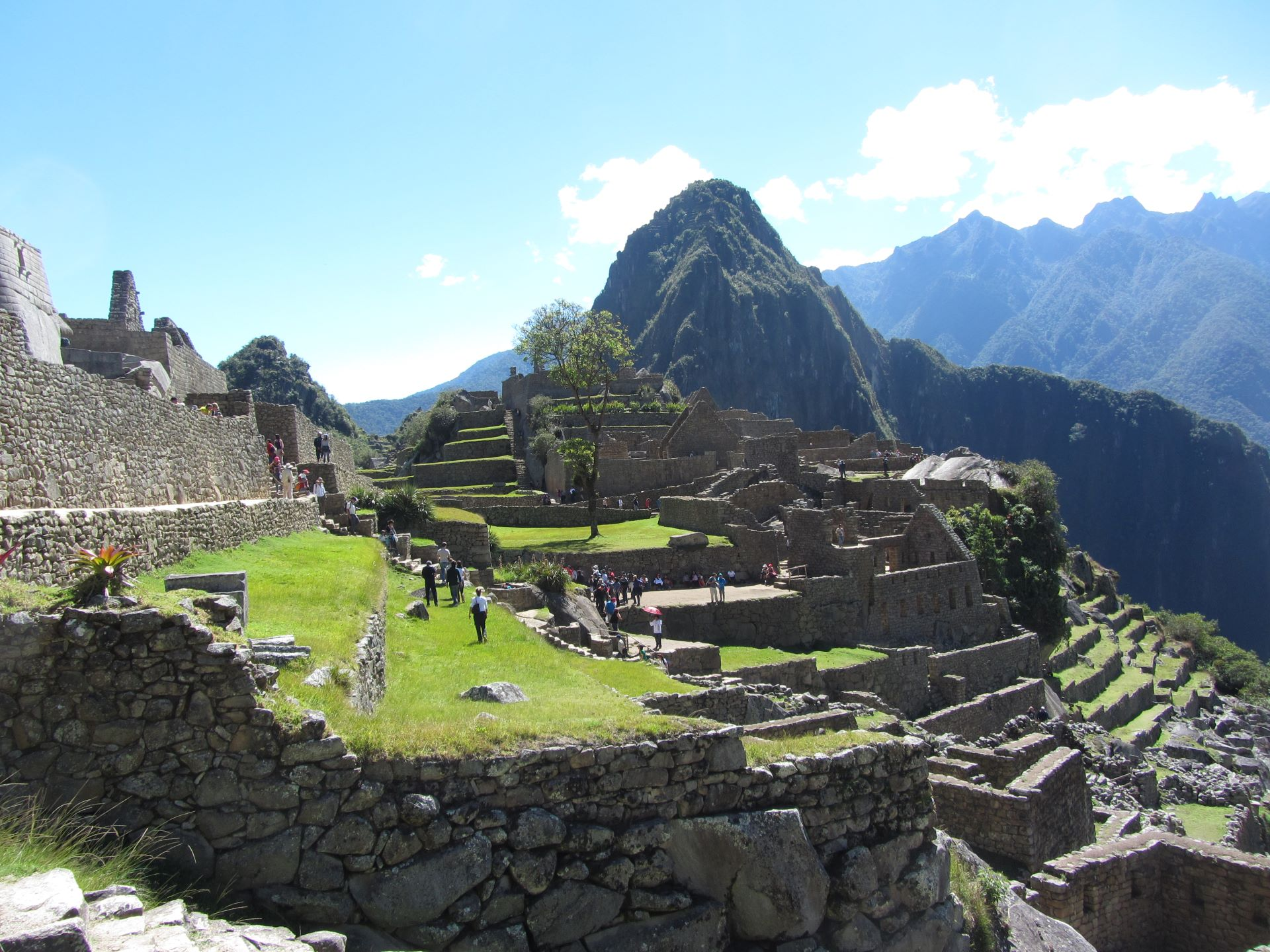
Machu Picchu Citadel – The tall mountain peak is Huyana Picchu
We climbed to the Guard House, a small hut used for surveillance, and captured the iconic view of Machu Picchu with Huayna Picchu in the backdrop.
We explored various viewpoints and saw the ariel view of the Urubamba River valley below.

Blue Planet Travellers
Rock steps to climb down the terrace

Blue Planet Travellers
Andes Mountain ranges from the Guard House
By 2:00 PM, day tourists had mostly left, and we had the place to ourselves with just a few more visitors.
There were Llamas roaming around the citadel, fearlessly standing at the mountain edges. We wondered how they have good balance even when standing at the edges.
Evening at Aguas Calientes
In the afternoon after relaxing for a while, we explored the town of Aquas Calientes and saw the Urubamba River at several points.

Blue Planet Travellers
Fiesta de la Virgen del Carmen festival

Blue Planet Travellers
Celebrating tradition with dance
We were there in mid-July, and Aguas Calientes celebrates the Fiesta de la Virgen del Carmen festival around this time every year.The celebration includes processions, some music, and native dances, all happening right there before our eyes, allowing us to enjoy local culture.
Day 2 – Sunrise, Huayna Picchu, and Sun Gate, Machu Picchu Citadel

Blue Planet Travellers
Early morning view of Machu Picchu citadel
We aimed to see sunrise, hike the Huyana Picch, do the Sun Gate trek along with a second visit to the citadel.
It was cloudy at 6:00 AM, but the misty views of Machu Picchu and the Andean Mountains were mesmerizing.
We planned to do Huyana Picchu together but due to the age limit being minimum 12 years, Varun was
not allowed to do it. So me and Varun stayed back and Shekar went alone.

Blue Planet Travellers

Blue Planet Travellers
After about three hours, Shekar returned from his adventurous hike to Huayna Picchu. From his experience, the hike was extremely thrilling. There were no railings to hold onto, making it definitely unsuitable for people with vertigo or a fear of heights. He mentioned that he often encountered traffic jams on the trail, as climbers (including himself) would stop not to admire the scenery, but to proceed very cautiously, one misstep could send them plummeting nearly 2 kilometers into the valley below. Despite the risks, Shekar felt the experience was absolutely worth it. Glad he was able to make it. With what he described I probably might have not made it with my fear of heights anyways.

Blue Planet Travellers
Llamas

Blue Planet Travellers
View from Huyana Picchu

Blue Planet Travellers
Walking trail to the Sun Gate

Blue Planet Travellers
View of Machu Picchu from the Sun Gate
We all then headed to Sun Gate trail. The trail to Sun Gate took us little over two hours (round trip) and offered incredible views of Machu Picchu and the Andes along the way.

Blue Planet Travellers
View from Sun Gate Trail

Blue Planet Travellers
On the Sun Gate Trail
We returned back, fully exhausted but overjoyed. Machu Picchu was one of the most memorable experiences of our travels.
We did not do the Inca Trail due to age restriction for Varun, and is still on our list for future visits.
A Memory We’ll Always Cherish
Machu Picchu is also one of the rare places we felt we might want to return to, there were only a few destinations in our travels that left us wanting to go back, and this is definitely one of them. It is truly one of those journeys we will always talk about and remember fondly.

Blue Planet Travellers
Travel Tips, FAQ -Machu Picchu Travel Guide
- Best time to visit: May to October. June and July are peak months with good visibility.
- Do we need passports?: Yes, Passports are required to visit Machu Picchu and will be checked at the entrance. Soft copies are rarely accepted, so you must carry your physical passport.
- How to reach Machu Picchu?
- Transfer from your Cusco Hotel to one of the train staion. (refer to details below in the recommended tours section)
- Take the train to Aguas Calientes (refer to details below in the Train to Machu Picchu all you need to know section)
- Then 30-minute bus from Aquas Calientes to Machu Picchu.
- Operating Hours: Machu Picchu is open 6:00 AM to 5:30 PM. Standard tickets allow 4 hours, Huayna Picchu tickets allow up to 6 hours.
- Walking in Machu Picchu Citadel is tiring with its steep staircases that we have to walk several times
bring water, sunscreen, sunglasses, and a hat or umbrella. - Access to Huayna Picchu limited to 350 people/day and has age restriction of Minimum 12 years old.
- Aguas Calientes is a small town and walkable and takes about 15 minutes to go around. There are No taxis or Uber. Local people at the station can carry luggage to the hotel for a fee.
- Can children do Inca Trail? Minimum age to do the Inca trail is between 7-12 years depending on the tour operator and the circuit.
- High Altitude Reminder Since Machu Picchu is at a high altitude, some visitors may feel a little lightheaded or slightly nauseous. If you’re sensitive to motion sickness or altitude, you might want to carry any medication you normally use, just in case. Taking it slow and staying hydrated usually helps.
Tickets to Machu Picchu
Tickets to Machu Picchu can be bought here if you want to explore on your own.
If you prefer to have a guide we recommend this tour that includes Machu Picchu guided tour with tickets and bus from Aquas Calientes.
Train to Machu Picchu all you need to know
Cusco is the nearest large town from where the journey to Machu Picchu starts for most tourists.
There are three main stations in and near Cusco from where trains depart to Machu Picchu
- San Pedro, about 10 minutes from downtown Cusco
- Poroy, about 30 minutes from downtown Cusco
- Ollantaytambo, about 1 hour and 30 minutes from downtown Cusco.
Though Ollantaytambo train station is far from Cusco Downtown, this is where most tourists board the train to Machu Picchu.
There are several reasons for this.
The trains from Ollantaytambo to Aguas Calientes start early in the morning and take about 1 hour and 30 minutes to reach Aguas Calientes.
This gives tourists more time to spend at Machu Picchu without getting exhausted. From Aguas Calientes,
the bus to the top of the Machu Picchu Citadel takes about 30 minutes. So most tourists prefer this.
Tourists often stay the night before in Ollantaytambo and start their Machu Picchu journey early the next morning.
There are two main train operators, Inca Rail and PeruRail, that operate trains between Cusco and Aguas Calientes.
There are different kinds of trains: Expedition (PeruRail), Voyager (Inca Rail), and Prime (Inca Rail). From our experience, we recommend Expedition for families because it is economical and has panoramic windows.
Train luggage limits: Only 8 kgs per person (backpack max 100 cm, carry-on 115 cm). Storage facilities are available at the stations.
Passports are required to board the Machu Picchu train. Soft copies are rarely accepted, so you must carry your physical passport.
Bus from Aqua calientes to Machu Picchu
Buses from Aguas Calientes take about 30 minutes to the Machu Picchu citadel. Machu Picchu bus tickets are required to board the Machu Picchu bus in Aqua Calientes to the Citadel entrance(Machu Picchu). It costs about USD 35 approximately for round gtrip. Tickets can be purchased online at comprar.consettur.com or in person at the ticket office in Aguas Calientes with a passport. The ticket office is located on Calle Mayta Cápac in Aguas Calientes. You can purchase your ticket in advance at the ticket office. They are open every day from 5:00 AM to 9:00 PM.
Tickets for bus from Aguas Calientes to Machu Picchu are purchased from Consettur website.
If you intend to purchase in person, The ticket office is located on Calle Mayta Capac in Aguas Calientes, or close to the bus station on Avenida Hermanos Ayar.
You have to pay them cash in local currency.
Tours we Recommend
Cusco to Ollantaytambo Transfer and tours
This Getyourguide tour takes you to Sacred Valley tour from Cusco and drops you off at Ollantaytambo as optional dropoff. This is excellent as you get to tour the Sacred Valley which is one of the main attractions in Cusco and also get the free ride to Ollantaytambo.
Or you may book this transfer directly from Cusco to Ollantaytambo
The trip from Cusco to Ollantaytambo is approximately 1 hour and 30 minutes, everything will depend on the traffic of the city.
Leave a Reply