
Three Days in Cusco: Complete Itinerary, Where to Stay, Tours & Travel Tips
Cusco is a city in the Peruvian Andes. It is the historic capital of Peru and is famous for its Spanish colonial architecture.
Our goal for these three days was to travel to Cusco from Puno, enjoy the beauty of the Andes, and learn some history along the way. We also planned to explore Cusco and visit the Sacred Valley and Ollantaytambo. We would finish our three day trip in Ollantaytambo
Where We Stayed
Cusco
Antigua Casona San Blas is about 8 minute walk to the Main square – Playa De Armas. It was cozy and beautifully decorated. The rooms were big and staff were friendly.
Ollantaytambo
El Albergue Ollantaytambo hotel was just inside the Ollantaytambo train station complex. The train stopped right in front of the hotel. The hotel had its own organic farm. At night, one of the office rooms in the station was converted into a dining area and dinner was served along with vegetables from the farm. Candles and music created a magical atmosphere.
The PeruRail train arrived a few hours earlier than departure, giving us a chance to take as many pictures as we wanted. Varun had fun going in and out of the train several times.

Blue Planet Travellers
Cathedral de Santa Domingo
Day 1 Puno to Cusco – Route of the Sun
Our journey began with a scenic bus trip through the Andean countryside, with guided stops at several spots along the way before we reached the city and settled in our hotel which took about 9 hours of travel. This route between Cusco and Puno is called the Route of the Sun.
We boarded the first-class bus. The bus stopped at various points of geographical and cultural interest along the way.
Our first stop was at Pukara after 2 and half hour of journey on the bus.

Blue Planet Travellers
Travelling the Sun Route

Blue Planet Travellers
Wiracocha Temple
Pukara
This is the most important and oldest ceremonial site this side of Tiahuanaco. It is famous for its pre-Inca ruins, local pottery. We had about 30 minutes here to enjoy the place and look around. The ruins here revealed some litho-sculptures and tombstones, all proof of a pre-Inca civilization, believed to be one at the origin of the Andean culture of the Altiplano. It was an interesting short stop.

Blue Planet Travellers
Vicunas at La Raya
Another hour and a half we enjoyed the view of Andes mountain from the bus before our next stop at La Raya.
La Raya
The highest pass on the route between Cusco and Puno, La Raya is 4,335 meters above sea level. Beautiful landscapes awaited us, and we got to see some vicunas. This region lies between two cultures, Quechua and Aymara, and is a blend of two distinct terrains: the dry, arid altiplano and the more verdant Quechua valleys and rivers.
It was just a short 15-minute stop to enjoy the view and take some pictures. We were more focused on the vicunas than on the mountains themselves and didn’t realize it was already time to board the bus.
Now the bus started heading to our next stop. With our early morning departure, the summer weather, and the long bus ride, we all started taking a nap. No matter how hard we tried to stay awake, even with the beautiful views of the Andes Mountains, it was difficult to keep our eyes open. After about an hour and a half, our bus stopped at the next attraction.
Raqchi – The Temple of the God Wiracocha
Wiracocha temple is about 121 kilometers from Cusco. It is a monument with 100 meters in length, 26 meters in width and 14 meters in height. Divided into two aisles each of these still retains the base of eleven giant columns. The base of the walls consists of Imperial Inca stonework with an upper section made of adobe. Adjacent to the temple,
we can see many rectangular storage, used for various purposes, both military and religious. We walked around
the temple, it was late July and burning hot but still we enjoyed the view of the Andes and the river Vilcanota. We had about 30 minutes here and then we headed back to the bus.
Cusco
Again a little over an hour in the bus we arrived at Cusco.
It took us about 10 minutes drive from the bus stop to get to our hotel which was very close to Cusco Main Square, or Plaza de Armas.

Cusco – View from the Cathedral
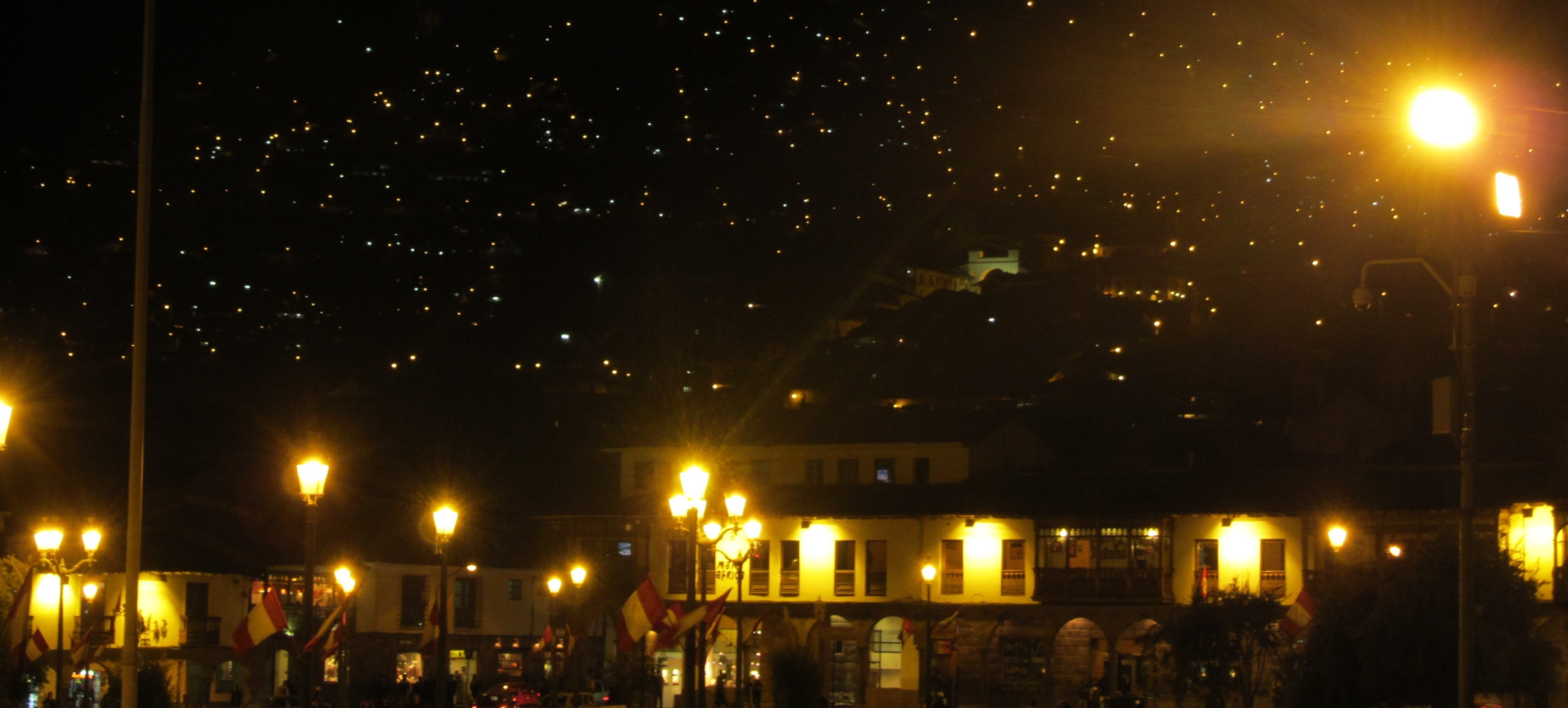
Once we settled in our hotel, we came out and it was already getting dark. We saw the famous Cathedral and walked around it. The Andes mountain ranges were seen in the background of the City. After a while it got dark and slowly we started seeing the lights on top of these mountains turn on one by one. And it gave a beautiful stary look. There were some restaurents in that area where we had our dinner and went back to sleep as we had a tour of Cusco the next morning.
Day 2 – Exploring Cusco
Morning: Cathedral Tour
With our location just a few minutes walk from the Cathedral, we simply went to the entrance and bought tickets for the guided tour. The tickets were about $12 USD for adults and $6 USD for children. We waited for the tour to begin. A few minutes later, our guide arrived, and there were about 20 people in the group.
We learnt the Cathedral de Santa Domingo is one of the finest and oldest to be found in South America. It’s construction started in 1560 and was completed in 1664. The design is constituted by a Latin – Cross base, the facade has a Renaissance style and very ornamental. It is believed to be the best work of colonial goldsmiths and wood carvers. It also contains a valuable collection of paintings from the famous Cusco School.
Later, we were given time to go around the church and we noticed that unlike Churches in Europe, this Church had Black rock floors and pillars resembling temples in Asia. Almost all the walls and pillars were covered with gold-colored decorations. It is a large church with lots of colonial paintings, and we found a Cusco version of the “Last Supper” painting adjusted to the region as Jesus and his companions are dining on Guinea Pig.
The tour lasted about 2.0 hours and we had enough time to have lunch before our next tour started for the day.
Afternoon: Half-Day City Tour
We were picked up from your hotel around 1.30PM for a half day tour of Cusco and the most important surrounding sites. We were told that this 4 hour tour will give us a great idea of the impressive and important city Cusco once was and still is.
Our guide mentioned that the tour will start from the farthest site from Cusco. Our first stop was at Tambomachay.

Blue Planet Travellers
Spring water at Tambomachay

Blue Planet Travellers
Puka Pukara
Tambomachay: This Inca Site is supposed to be dedicated to the cult of water. This consisted of a group of walls united by stairs, there are springs that cascade to a pool through several canals that are cut out in the stones used to build this site. The waterfalls in these ruins form part of a terrace to the second wall where the drainage cascades on the first and forms a small pool. The holes in the window are 2 metres high, and according to historians, the Inca and the most important people of his court offered water rites to the Sun God Inti.
Puka Pukara: After a short drive we reached Puka Pukara. The name of this small site translates into “Red Fortress” in Quechua, the local language. The site is thought to be a defensive post between Cusco and the Sacred Valley and is located on the old route to Calca, one of the mayor villages in the Sacred Valley. It may also have served as a resting point for travellers between these destinations.

Blue Planet Travellers
Q’enqo The main boulder

Blue Planet Travellers
The cave at Q’enqo
Q’enqo: After Puca Pucara we drove a few kilometers and we were at the site of Q’enqo. The main part of this site is a huge boulder that is surrounded by a type of natural amphitheatre. The main boulder is worked with different sculptures of different animals that have a special significance to the Inca. The site is also considered to be used for astronomical observations, including, for calendar making.

Blue Planet Travellers
Angled walls considered the teeth of the Puma

Blue Planet Travellers
View from the top of the fortress Sacsayhuaman
Sacsayhuaman: From Q’enqo it was only a short drive to the enormous fortress of Sacsayhuaman. It is considered to be one of the most famous sites of the Inca. Its Quechua name means “satisfied falcon”, as it was the falcon that guarded the capital of the empire. Cuzco was designed in the shape of a lying puma with Sacsayhuaman as its head (the angled walls being the teeth of the puma). The area where now the Plaza de Armas is located is the space between the legs of the puma, while the rivers outline the shape.

Blue Planet Travellers
Sacsayhuaman Fortress
Our guide also jokingly told us how to remember the name Sacsayhuamán as “Sexy Woman,” which made us all laugh.
Cathedral de Santa Domingo: Another short drive from here we headed for Cusco centre where we again visited the Plaza de Armas with it main Cathedral.
Most tours dont cover the inside of the Church. We went around the Cathedral and it was a short stop here.
Qoricancha: Lastly we visited the temple of the Sun. We learnt that this temple under the name Qoricancha was the most important temple in the Inca Empire, dedicated primarily to Inti, the Sun God. It was one of the most revered and respected temples of the city of Cuzco, Peru.
The walls and floors were once covered in sheets of solid gold, and the courtyard was filled with golden statues.
Spanish reports tell of its opulence that was fabulous beyond belief. The Church of Santo Domingo was built on the site using the ruined foundations of the temple that was flattened by the Spanish in the 17th century, and is a fine example of where Inca stonework has been incorporated into the structure of a colonial building. Major earthquakes have severely damaged the church, but the Inca stone walls, built out of huge, tightly-interlocking blocks of stone, still stand proudly and is compared to the modern day Lego blocks.
Our tour of Cusco city ended here and we were dropped back at our hotels. It was a long day and we had a tour to the Sacred Valley the next day, so we had dinner and went to sleep.
Day 3 – Sacred Valley of the Incas
Today we were picked up from our hotel for a full day excursion to the Sacred Valley of the Incas. After a little over one hour journey, we reached Moray, our first stop for the day.
Moray: At Moray, we saw agricultural terraces built along the hillsides. We learnt that these terraces were built by the Incas to grow an abundance of crops on less-than-ideal mountain terrain. Another 10 min drive and we reached Moras.
Moras: We saw several salt ponds(over 5000) which were used by the Incas for salt extraction. They are owned by the families that live in this region and they redirect saltwater from the stream nearby and have built this looking salt mines which were amazing. Each one was about a few square metres. They used this salt to preserve their food.

Blue Planet Travellers
Lunch stop at Restaurant

Blue Planet Travellers
Local handicrafts and souvenirs from Pisac at the Restaurant
After this we stopped at Urubamba, the capital of the Sacred Valley, for lunch. The restaurant at Urubamba was located in a beautiful place surrounded by Andean mountains, the Urubamba river flowing in the backyard, and parakeets flying around. We went down to the river in and enjoyed the scenic view and the calm waters of Urubamba river. It was a perfect place to relax.

Blue Planet Travellers
Urubamba River

Blue Planet Travellers
Varun at Urubamba river
The Sacred Valley of the Incas, is about an hours drive from Cusco was the main source of agriculture for the people living in Cusco. It had large flat plains with the Urubamba River flowing in centre of the Valley. We learnt that this area was vital for the Incas. It is also the entrance to the lower jungle areas and Machu Picchu. We entered the Sacred Valley by road coming from Cusco and crossing the highland between Cusco and the Valley and then suddenly dropping into the Valley.
We noticed the grass in the sacred valley was not green as we had seen in pictures. They looked dry as it was hot. We were there in late july. It was little concerning for us, as we thought Machu Picchu might look the same. But Machu Picchu was all green when we visited the next day.

Blue Planet Travellers
Sacred Valley of the Incas and the Urubamba river

Blue Planet Travellers
Sacred Valley
Along the way we stopped at several points to see the agricultural steps on the mountains.

Blue Planet Travellers
Sacred Valley of the Incas view from the top of the hill
Our next stop was at the town of Pisac. Pisac is home to one of the most famous artisanal markets in Peru and even South America. There were rows and rows of shops with colorful Peruvian souvenir and artisanal work. We did a quick souvneir shopping here.

Blue Planet Travellers
The 200 steps at Ollantaytambo

Blue Planet Travellers
The first steps
Ollantaytambo: Ollantaytambo is an attractive little town located at the western end of the Sacred Valley. The town has been built in Inca times and is the best surviving example of Inca town planning. The town is located at the foot of the impressive site of Ollantaytambo. This site, a steep collection of large staircases leading up to a strange set of walls and constructions was never completed and would have been even more impressive if they were ever finished.

Blue Planet Travellers
Ollantaytambo town in the valley between tall Andean peaks
We had to climb some 200 steps to reach to the top, and the view of the town of Ollantaytambo in the valley between the mountains was panaromic. The centerpieces of this site are for sure the 6 huge monoliths that stand apparently glued together on top of the mountain.
We then came to the end of our tour. We realized we had been climbing up and down the mountains peaks all day.
Very much to be expected in Peru especially in the Andean mountain region. More did we at Machu Picchu.. so get prepared!!

Blue Planet Travellers

Blue Planet Travellers
We opted to be dropped back at our hotel in Ollantaytambo, so we could continue our journey to Machu Picchu the next day. Staying at Ollantaytambo actually gave us some extra time in the evening as our train to Machu Picchu will leave Ollantaytambo at around 6:00AM the next morning. Our hotel in Ollantaytambo was right at the train station which was convenient to board the Perurail for our Machu Picchu journey.
Travel Tips, FAQ – Cusco – Travel Guide
How to reach Cusco?
Flying to Cusco is the better option when arriving from Lima. In this post below, we share our experience travelling from Puno to Cusco by bus.
Best time to visit: The best time to visit Cusco is closely aligned with the best time to visit Machu Picchu, as most travellers come to Cusco since it is the gateway to Machu Picchu.
Nearly all Machu Picchu tours depart from in and around Cusco.
Best time to visit Machu Picchu is May to October. June and July are peak months to visit Machu Picchu with good visibility.
Best time to visit Cusco is from June to September.
Are there Uber in Cusco? Yes, Uber is available in Cusco and it’s the most affordable and convenient way to get around the city.
The Closest Airport to Cusco is Alejandro Velasco Astete International Airport (CUZ).
High Altitude Reminder: Since Cusco is at a high altitude (3400 meters above sea level), some visitors may feel a little lightheaded or slightly nauseous. If you’re sensitive to motion sickness or altitude, you might want to carry any medication you normally use, just in case. Taking it slow and staying hydrated usually helps.
Flying vs. Bus Puno to Cusco: Flights from Puno to Cusco vary in duration, with the fastest taking about an hour and a half.
However, it can be difficult to find a flight at a convenient time. Moreover, most flights from Puno to Cusco take around 4 to 6 hours.
On the other hand, the bus from Puno to Cusco takes approximately 7 to 9 hours and is often a more convenient option.
Bus from Puno to Cusco: The first-class buses from Puno to Cusco are one of the most comfortable in Peru. The bus stops at various points of geographical and cultural interest along the way. You get to explore the country more while transfering at the same time.
Tickets for Bus from Puno to Cusco can be bought here
Stay Hydrated It’s crucial to stay hydrated in the summer heat in Peru. Most of the tours involve climbing mountains a few times a day. Bring lots of water with you.
Sunscreen Make sure to protect your skin from those harmful UV rays while you’re out enjoying the Peruvian sunshine especially during the peak seasons June-July.
Tours we Recommend
Cusco City Tour You visit several Inca sites in Cusco in this Cusco: City Tour | Half-Day Tour to 4 Archaeological Sites
Sacred Valley Tour and Cusco to Ollantaytambo Transfer
This Getyourguide tour takes you to Sacred Valley tour from Cusco and drops you off at Ollantaytambo as optional dropoff. This is excellent as you get to tour the Sacred Valley which is one of the main attractions in Cusco and also get the free ride to Ollantaytambo.
Or you may book this transfer directly from Cusco to Ollantaytambo
The trip from Cusco to Ollantaytambo is approximately 1 hour and 30 minutes, everything will depend on the traffic of the city.
Leave a Reply