
Brazilian Side of Iguazu Falls from Argentina: The Ultimate Guide to Views, Border Crossing and Travel Tips
We started our journey from Argentina to the Brazilian side of Iguazu Falls, known as Cataratas do Iguaçu in Portuguese and Cataratas del Iguazú in Spanish. Having visited the Argentinian side of the Iguazu falls the previous day and taken the unforgettable boat ride under the waterfalls, we were curious to know what more the Brazilian side could possibly offer us.
Iguazu Falls is one of the Seven Natural Wonders of the World, located on the border between Brazil and Argentina. Visiting it is a must if you’re in South America, and most travelers explore it from either Foz do Iguaçu in Brazil or Puerto Iguazú in Argentina. Each side has its own charm, and while some people say the Brazilian side isn’t as impressive as the Argentinian side, we didn’t quite see it that way.
We decided to take a tour of the Brazilian side, starting from our hotel in Argentina. Our guide asked for our passports for the border crossing, and within about ten minutes at the Argentina-Brazil border, everything was stamped and ready. A short drive later, about twenty-five minutes, we arrived at the Brazilian entrance to the falls.
On the way, the guide asked if anyone had already visited the Argentinian side and taken the boat ride. Everyone on the bus had, and so had we, the day before. He said not to expect too much, suggesting that after the boat ride, there wasn’t much left to see.
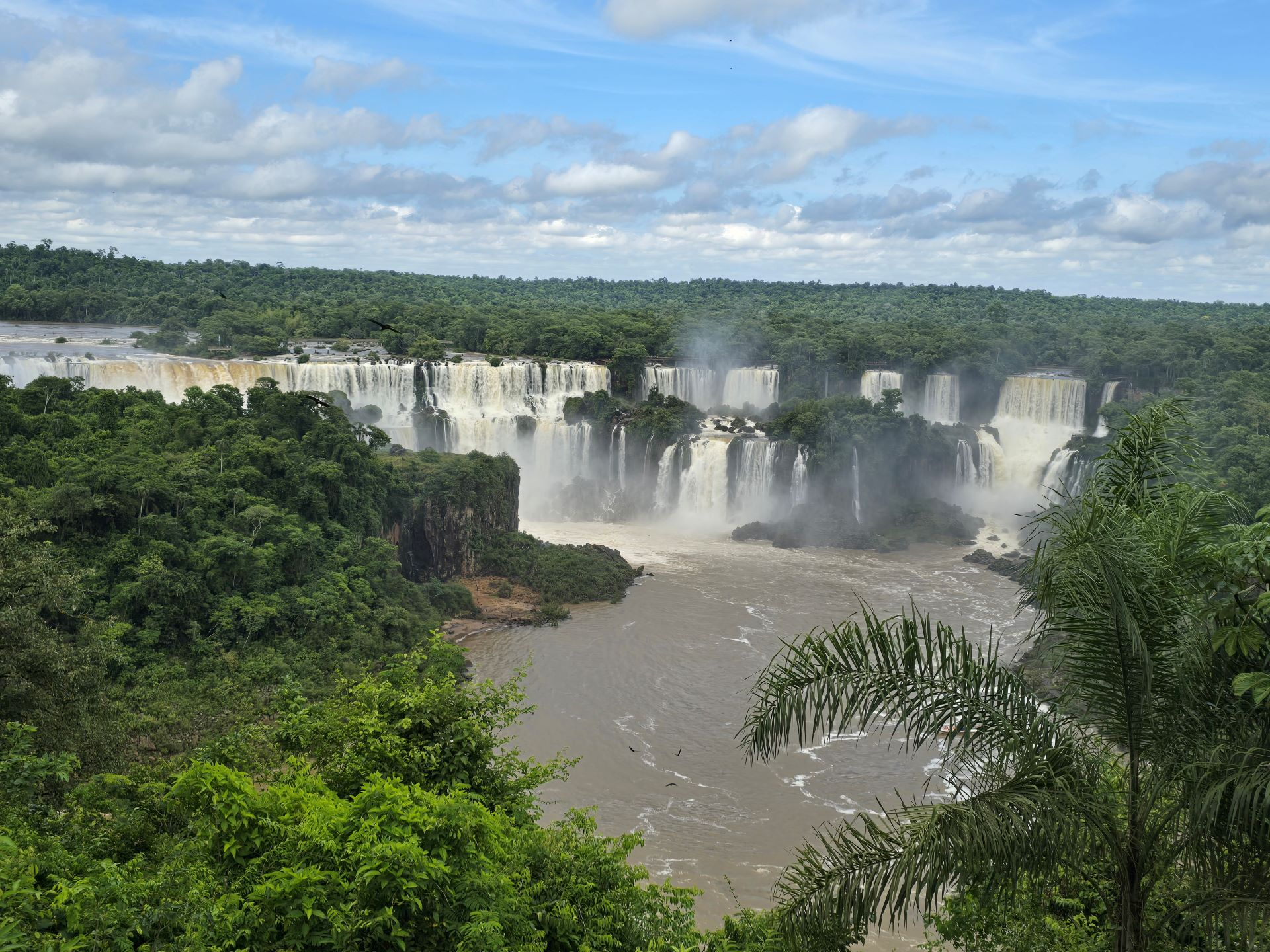
But we didn’t think that was true at all. The Brazilian side offers a completely different view, with sweeping panoramas and a new way to experience the falls. By the time we stepped out and saw it for ourselves, it felt like a whole new adventure.
Iguazu Falls
Iguazu Falls consists of 275 individual waterfalls, referred to as drops, with an average height of approximately 75 meters and spans about 2.5 kms. It is the largest waterfall system in the world. The Brazilian side of the falls is located within Iguaçu National Park. As soon as we got off the bus, there it was. Iguazu Falls curved dramatically through the rainforest, with its roaring sound echoing through the air. It was instantly picture perfect. We noticed the ticket office, but since our tour included pre booked tickets, we did not need to go through that process. From here, the tour guide left us to explore on our own.

Blue Planet Travellers
View of Iguazu falls – Brazil from walkway

Blue Planet Travellers
View of Iguazu falls – Brazil from walkway
Walking the Waterfall Trail
We walked along the river trail through the rainforest, with Iguazu Falls and the river flowing to our right. There was a railing along the entire path and several viewpoints where we could stop whenever we wanted to soak in the incredible scenery. Eventually, we reached the famous walking bridge along the Trilha das Cataratas, also known as the Waterfall Trail. The bridge stretched over the river, and as soon as we stepped onto it, the view was unbelievably beautiful. The floor of the bridge was just a few feet above the water, and we could feel the vibration of the rushing water beneath us. To our left, the stunning Floriano Falls dropped powerfully from above. To our right, waterfalls plunged downward below us, and in front of us multiple cascades fell dramatically from the water running underneath the bridge. The entire region was filled with the thunderous sound of waterfalls. With falls above and below us, we stood in the middle of the river, completely surrounded by the Iguazu River and its cascades. It felt like a three dimensional experience, absolutely mesmerizing.
We stopped at every viewpoint to truly take it all in and were completely drenched by the mist and showers from the waterfalls. Luckily, we had brought ponchos and waterproof phone covers, which allowed us to stay longer. Several tourists turned back within minutes because they did not have ponchos, and there were no nearby shops selling rain gear.

The bridge ove the Iguazu river
The 360 Degree Platform Experience
At the end of the bridge, there was a circular platform offering a full 360 degree view of the falls. We were told that from this point, you can see approximately 82 percent of all the waterfalls across both Argentina and Brazil. We were blown away. It was far more than we had expected, especially after what our tour guide had said earlier. This experience alone proved that the Brazilian side should never be underestimated.

The end of the bridge with 360 degree view
The bridge is about 1.5 kilometers long (the walk felt much shorter than that), and we spent nearly an hour in this area. It was very crowded, as tourists were trying to capture as many memories as possible through photos, and we definitely did not want to miss that either. Afterward, we walked back across the bridge and continued along the trail, moving farther into the park.
The Panoramic Elevator and Upper Viewpoint
At the end of the trail, there were restaurants, shops, and a panoramic elevator that takes visitors to an upper level viewpoint, another incredible spot that should not be missed. There was a long line, and we waited about thirty minutes for our turn. The elevator ride itself lasted only a few seconds. There is no walking access to reach this upper level, as the viewpoint is partly under the falls.
When it was our turn, we stepped into the elevator. We were told that the view during the ascent was amazing, but it was so brief that it was difficult to fully grasp what we were seeing.

At the Floriano Falls
Once at the top, we were rewarded with spectacular panoramic views of the Floriano Falls. The roar of the water was intense, with massive volumes cascading downward. We walked along the viewing platform and were able to get incredibly close to the waterfall, close enough to actually touch it. The floor of the viewpoint was made of mesh built over the falls, and we could see the river rushing below through the openings. The water soaked us once again, another shower from Iguazu Falls. A different angle, a different waterfall, but equally powerful and unforgettable.
Aerial Views and Final Moments

Aerial view of the bridge from the upper viewpoint
From the upper level, we continued along another trail to yet another viewpoint. This one offered an aerial view of the bridge and the surrounding waterfalls. It was a circular path with restaurants and shops along the way. We spent a few minutes walking around before meeting our tour guide and returning to the bus.

The cascading waterfalls and the bridge from the upper viewpoint
We had also booked a visit to the bird park and were dropped off there afterward. The entrance fee was about 10 USD, which we paid on arrival. We explored Parque das Aves and were amazed by the number of bird species. There were far more birds than we had expected. After about an hour, we were picked up and headed back to Argentina, stopping once again at immigration before crossing the border. Once we were back in Argentina, our tour operator returned our passports to us. It was a full day, and one that completely changed our perception of the Brazilian side of Iguazu Falls.

Blue Planet Travellers
Toco Toucans in the bird park

Blue Planet Travellers
Iguazu Falls – Brazil
Where to stay
Before choosing a hotel, it helps to know the main cities where you can base yourself. You can stay in Puerto Iguazú on the Argentine side or Foz do Iguaçu on the Brazilian side. Both cities provide easy access to their respective sides of the falls, and it’s simple to cross the border from one to the other if you want to explore both in separate days.
Recommended Hotels:
Hotel Saint George in Puerto Iguazu This hotel is in the middle of the town, surrounded by restaurants. The rooms were large, and it had a beautiful garden by the pool.
Hotel Rafain Centro The hotel is in a central location, about a 7-minute drive from Iguazu Falls. The breakfast was really good.
Tours We Recommend in Iguazu
The easiest way to visit the Brazilian side of Iguazu Falls on a day trip from Puerto Iguazú (Argentina) is by booking a guided tour. We recommend the following tour:
- Puerto Iguazu – Iguazu falls Brazilian side
The tour operator handles the transfer and visa stamping and paperwork at the Argentina-Brazil border and arranges entry into Iguaçu National Park. Always check your country’s visa requirements when travelling between Argentina and Brazil to avoid any issues at the border. - Puerto Iguazu -Iguazu falls and Boat Ride Argentinian side Our tour guide picked us up from Puerto Iguazú and took us straight to the falls. The tickets were all arranged in advance, and the boat ride was included. Just a heads-up: the boat ride is only for those aged 12 and above, so younger kids can’t go on it.
These tours are a must when visiting Argentina and can easily be added to your 2-day Iguazu Falls itinerary.
Tips and FAQ
Closest Airport
There are several airports near Iguazu Falls on both the Argentinian and Brazilian sides. The nearest airport on the Argentinian side is Cataratas del Iguazú International Airport (IGR), located just 7.7 km away. Other nearby airports include Foz do Iguaçu International Airport (IGU) in Brazil (8.6 km), Ciudad del Este Airport (AGT) in Paraguay (45.5 km), and Cascavel Airport (CAC) in Brazil (120.7 km).
Best Time to Visit
Iguazu Falls can be visited year-round, with each season offering a different experience.
December -February (Summer / Peak Season)
These are the hottest months, with temperatures ranging from 30-40°C. This is also when the waterfalls are at their fullest due to higher rainfall. The increased water flow creates powerful cascades and refreshing mist along the trails, you’ll likely get soaked, which is all part of the experience.
March – May (Autumn)
Temperatures are milder, ranging from 16-27°C, making it a pleasant time to visit. However, humidity levels can still be quite high.
June – August (Winter)
Cooler and generally more comfortable, with temperatures between 10-20°C. Water levels may be lower compared to summer months.
September – November (Spring)
Temperatures range from 14-26°C, offering a balance of comfortable weather and moderate water flow.
Located within a subtropical rainforest, Iguazu Falls receives rainfall throughout the year, so occasional showers are always possible.
Our recommendation: Visit in December to see the waterfalls at their most powerful. Although it’s one of the hottest months, the trails on both the Argentina and Brazil sides wind through the rainforest, which keeps the walk cooler. At nearly every lookout, you’ll be treated to a refreshing shower from the falls, a most important part of the Iguazu experience.
Separate days for each side
We recommend exploring the Argentinian and Brazilian sides on separate days. Each offers a unique perspective, the Argentine side has more trails and closer views, while the Brazilian side provides panoramic vistas along with closer views. Don’t skip either!
What to pack for Iguazu Falls
Bring ponchos, phone covers, and camera protection. There are no shops for rain gear on the Trails of Iguazu both in Argentina and Brazil. Many tourists couldn’t finish the trails because they were worried about getting their phones and cameras wet, be prepared!
Walkway Accessibility
The walkway is mostly flat and easy to navigate, but it is not fully wheelchair accessible, with a few steps to climb roughly every 100 metres.
Boat Ride Essentials (for Argentina Side of the Falls)
On the boat under the Iguazú Falls, you’ll get fully geared up for the splash! Everyone goes barefoot, so no need for shoes or slippers. You’ll also receive a massive waterproof bag to toss in your phone, keys, shoes, or anything else you want to keep dry. And, of course, a life jacket is provided to keep you safe as you enjoy this unforgettable, soaking adventure. Reminder, the boat ride is only for those aged 12 and above, so younger kids can’t go on it.
Leave a Reply