
Japan at Night: Things to Do in Tokyo, Kyoto and Osaka After Dark
Have you ever noticed how different a place feels once the sun goes down? That was certainly true for us in Japan.
Some of our most beautiful views and memorable experiences happened after sunset. From looking out over Tokyo from high above the city to watching the lights of Shibuya, wandering through Gion, seeing the torii gates of Fushimi Inari after dark, and taking a boat through the bright lights of Dotonbori, nighttime gave us a whole new set of experiences to enjoy.
If you’re planning a trip to Japan, we hope these nighttime experiences from Tokyo, Kyoto and Osaka give you some ideas for your own evenings. We’ve also included a few nighttime tours and places to stay that you may want to consider along the way.
Want to explore more of Japan? Looking for itineraries for Japan? Travelling to Japan with kids? Or perhaps you’re looking for ideas on where to stay, what to see and do, or practical travel tips? Take a look at our other Japan posts here for more ideas, inspiration, and helpful information to help you plan your trip.
Tokyo at Night
Tokyo comes alive in a completely different way after dark. As the lights begin to turn on across the city, the streets seem to transform into another world, filled with colour, energy and people. The calm, orderly feel you notice so much in Japan during the day gives way to a lively evening atmosphere.
We experienced this side of Tokyo during our visit and are sharing some of our favourite moments from exploring the city after dark.

A view from Tembo Galleria

SkyTree – Tokyo
Tokyo Skytree
Tokyo Skytree is one of the best places to see the city from above, especially as evening sets in. From the Tembo Deck and Tembo Galleria, you can look out across Tokyo from hundreds of metres above the ground, and if you arrive around sunset, you get to watch the city change right in front of you. As daylight fades, the lights in homes and buildings begin to turn on one by one, and the view slowly transforms into a sea of tiny points of light. Watching Tokyo light up beneath us was spectacular.
And just to avoid any confusion, Tokyo Skytree is not the same as Tokyo Tower. They are two different landmarks in Tokyo.
If you’re planning to visit, you can buy your Tokyo Skytree tickets here.
The Skytree itself is beautifully illuminated at night, with its colours changing every few minutes. You may see it glowing blue, green, red and in other colours.
The tower stands among local businesses, offices and ordinary city streets, so getting a full picture of the entire Skytree isn’t always easy. However, it is visible from many places around the neighbourhood, and with a little exploring, you can find a good spot to capture the whole tower lit up against the night sky. The colourful illumination can only really be appreciated from outside.
Inside, the visit takes you through the Tembo Deck(350 metres) and then higher to the Tembo Galleria(450 metres) , which is the highest point accessible to visitors. The route follows a one-way path, so take your time as you make your way through both levels.

Blue Planet Travellers
Sunset from Tembo Deck

Blue Planet Travellers
Tembo Deck – glass floor
One thing we almost missed was the glass floor. It is actually a small section on the return journey. After reaching the Galleria, you make your way back toward the Tembo Deck, and this is where you’ll find it.
It is surprisingly easy to walk right past. With people standing on the glass, you may simply mistake the crowd for another busy part of the Tembo Deck. Keep an eye out for it on your way back, you don’t want to miss it. Looking straight down through the glass with Tokyo far below is an experience worth stopping for.
Shibuya Crossing After Dark

Blue Planet Travellers
Shibuya Crossing, Tokyo
Shibuya Crossing is one of the main attractions to experience while you are in Tokyo, especially after dark. There are five pedestrian crosswalks embedded into an intersection surrounded by 10 lanes of traffic, and when the pedestrian signal turns green, people begin crossing from every direction.
Shibuya Crossing is famous for having more than 2,000 people cross during a two-minute pedestrian signal interval. When we were there, honestly, it looked like there were even more than 2,000 people. From where we were standing, each crossing seemed to have roughly 800 to 1,000 people at a time, as you can see in our pictures.
We visited Japan during Golden Week, so we were expecting crowds. Interestingly, though, we actually saw bigger crowds at some of the shrines and temples than we did at Shibuya Crossing. Golden Week is an exceptionally busy time to travel around Japan, so our experience may not represent what you will see on a normal day. Outside of Golden Week, I can easily imagine Shibuya Crossing taking the crown when it comes to crowds.
On a normal weekday, Shibuya is also busy during the daytime, particularly around lunchtime (11a.m. -12 p.m.), when people working in the surrounding offices are out. We didn’t visit Shibuya Crossing during the day, though. We were in Tokyo for a limited amount of time and preferred to spend our daytime exploring other attractions rather than staying in the city.
For us, Shibuya Crossing after dark was the better choice.
What we found particularly interesting was that a large part of the crowd at Shibuya Crossing wasn’t simply trying to get from one side of the street to the other. Many people seemed to be there specifically for the experience, and for the photographs.
As soon as the pedestrian signal turned green, people ran right into the middle of the crossing to capture photos surrounded by the moving crowd. There were especially many young women dressed up beautifully and clearly ready for the perfect photograph. It was funny watching some of them wait for the next signal when their first photo attempt didn’t turn out quite right. Then they would try again! After all, we only have those two minutes while the pedestrian signal is green to capture that perfect moment before the crowd clears and the traffic starts moving again.
So, in a way, Shibuya Crossing felt more like an attraction in itself rather than a regular pedestrian intersection. People weren’t simply crossing the street, they were coming here to be part of the famous Shibuya crossing.
When to Visit Shibuya Crossing at Night
For the experience we had, I would recommend going around 9:00 – 10:00 p.m. This was when we found the crossing really coming alive with people, and the combination of the crowds and the enormous illuminated buildings surrounding the intersection made it an excellent time for photographs.
The lights from the surrounding buildings really add to the atmosphere after dark. With the crowds moving in every direction and the giant illuminated screens in the background, it is one of those places where the photographs can actually capture the feeling of being there.

Blue Planet Travellers
Thousand’s of people waiting for the signal at Shibuya Crossing, Tokyo

Blue Planet Travellers
Aerial view of Shibuya Crossing from MAGNET by Shibuya109
Seeing Shibuya Crossing From Above
If you have some extra time, it is also worth seeing the crossing from above. There are several buildings around Shibuya crossing that offer aerial views of the intersection and the crowds below, including Shibuya Sky, Magnet by Shibuy 109, Shibuya Hikarie, and Shibuya PARCO. We went up to one of them, and the view of the crossing at night was fantastic.
We tried one of these experiences, and the views were fantastic. They do come at a price, though. Expect to pay roughly $15–$30 per person, depending on the venue and experience. Some of these aerial lounges include a drink with the admission, which makes it a little easier to justify the price if you want to sit down, enjoy a drink and watch the crossing from above.
Seeing thousands of people move through the intersection from street level is impressive, but seeing that same crowd from above gives you a completely different perspective.
Overall, Shibuya Crossing was a great experience for us and, in my opinion, is a must-visit in Tokyo after dark. The bright screens, traffic, crowds and constant movement make it feel very different from visiting Tokyo during the day.
Shibuya Sky View After Dark
For a taste of Tokyo after dark, the Tokyo by Night: Shibuya Sky Views & Shinjuku Neon tour is a great way to experience two very different sides of the city in one evening. Start above the city at Shibuya Sky around sunset, then head into the bright neon streets of Shinjuku, including Kabukicho and the lantern-lit alleys of Omoide Yokocho. With a local guide sharing stories along the way and taking photos throughout the evening, it’s a fun option for seeing Tokyo transform from sunset to a vibrant nighttime city.
Kyoto at Night
Japan feels much quieter during the day, and Kyoto was no different. But as the sun goes down, the city slowly comes alive in its own way, the atmosphere remains calm and unhurried..

Blue Planet Travellers
Lanterns hanging in rows along Shijo-dori street, Gion

Blue Planet Travellers
A kimono rental shop at Hanamikoji Street, Gion
Unlike the energetic nightlife of Tokyo, where the city seems to explode with bright lights, crowds and activity after dark, Kyoto comes alive much more quietly. The crowds are there, but the beauty of the city seems to take over the noise. People slow down, walk through the beautifully lit streets and simply enjoy the atmosphere rather than rushing from one attraction to another.
For us, this quieter side of Kyoto was what made exploring the city at night so special.
Gion After Dark
Gion is Kyoto’s most famous district, renowned for its traditional Japanese ambience, and it comes alive beautifully after dark. Shijo-dori is the main street leading into Gion, and from there you can walk toward Hanamikoji Street and the surrounding traditional lanes. The lanterns hanging in beautiful rows along both sides of Shijo-dori added to the charm of the street.
If you’d like to explore Gion after dark with a local guide, the Gion Magical Night Walking Tour is a great option. The evening walking tour takes you through the atmospheric streets of Gion while sharing stories about Kyoto’s geisha culture, local traditions, and the history of the neighborhood. There’s also some fun geisha trivia along the way, making it a nice way to learn more about the area while experiencing Gion at night.
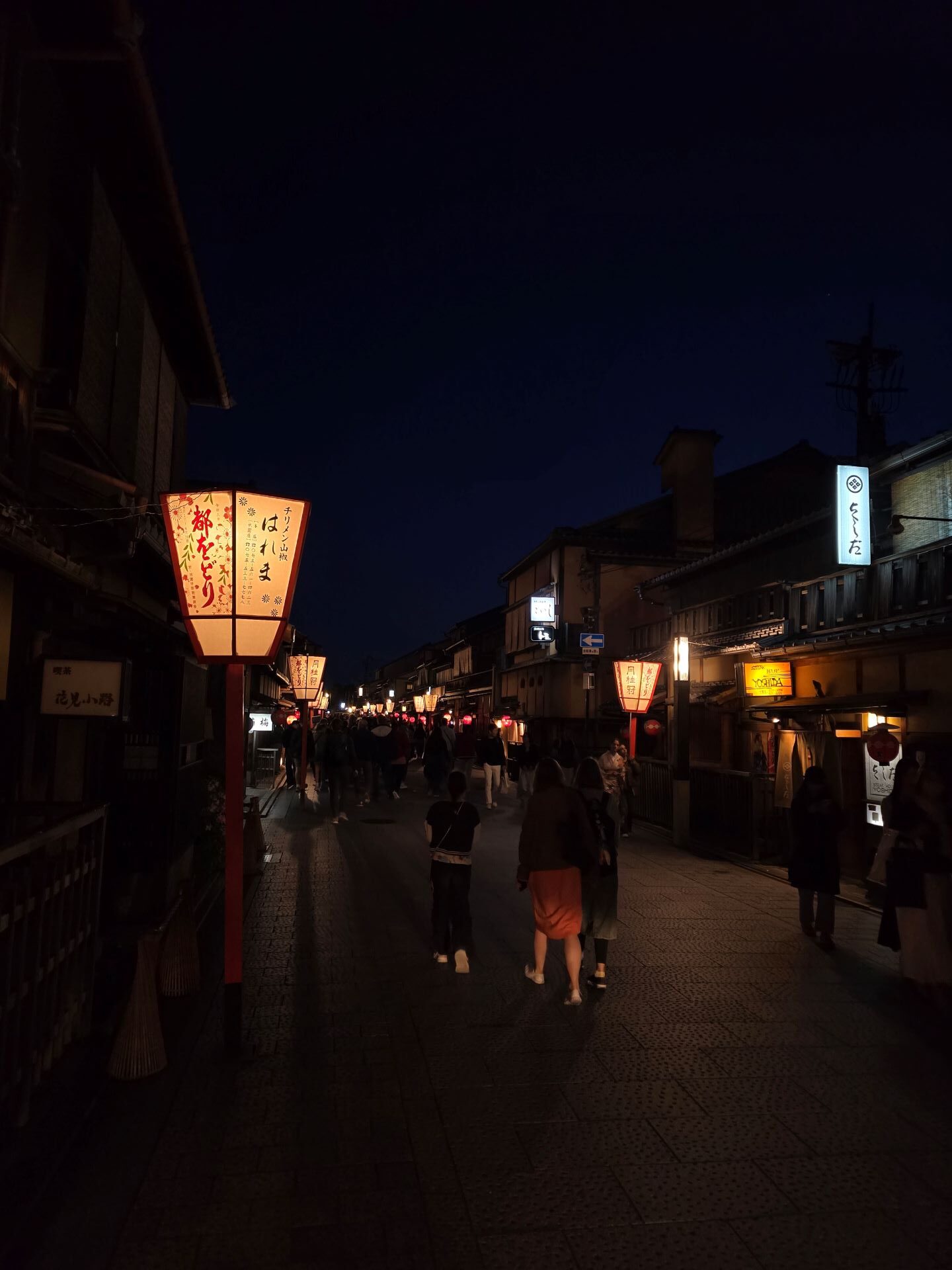
We loved walking through the colorful lights along Shijo-dori, and once we reached Hanamikoji Street, the atmosphere changed completely. The traditional wooden buildings, narrow street and softly lit lanterns felt almost like we stepped back in time. It was like experiencing a glimpse of Japan’s ancient past, right in the middle of modern Kyoto. Hanamikoji is the most Japanese-looking street we walked through in all of Japan.
The lanterns along Hanamikoji were especially beautiful. They were cone-shaped, almost rectangular lights with writing on them, not sure what they meant, possibly street names or addresses. Whatever they represented, the red and black writings over yellow lights added so much beauty and ambience to the street at night.

Lanterns at Hanamikoji Street, Gion

Blue Planet Travellers
Hanamikoji Street, Gion
We recommend arriving around sunset, having dinner in the area, and then walking through Gion as it gets darker. Many restaurants in the Hanamikoji are already full or close around 8 p.m., so arriving earlier gives you a better chance of enjoying dinner before exploring the streets at night.
For us, Gion and Hanamikoji were one of the highlights of Japan after dark. Unlike the bright neon of Tokyo, this is where you experience Japan through traditional architecture, warm lights and a quieter atmosphere.
A Yasaka Shrine After Dark

Blue Planet Travellers
Shijo-dori street from Yasaka Shrine
Yasaka Shrine is one of the nighttime attractions in Kyoto that you can easily combine with a visit to Gion and Hanamikoji Street. At the eastern end of Shijo-dori, you will find Yasaka Shrine, which takes on a beautiful appearance after dark. The shrine is illuminated at night, and the warm light makes its orange walls glow against the darkness.
We climbed a set of stairs to the entrance of the Shrine, and from there, looking back toward Shijo-dori, you can see the rows of lanterns stretching down the street. The view of the glowing lanterns along Shijo-dori, framed by the illuminated shrine, was especially beautiful at night and made this a perfect continuation of our walk through Gion.

Blue Planet Travellers
Yasaka Shrine, Kyoto

Blue Planet Travellers
Inside Yasaka Shrine
Fushimi Inari Shrine:When the Torii Gates Light Up
Fushimi Inari is one of Kyoto’s most recognizable attractions, known for the 10,000 bright orange torii gates that wind their way up Mount Inari. At the foothill of the mountain is a beautiful, large shrine complex, which you pass through before beginning the climb through the torii gates. The gates continue up the mountain through the forest, making the walk much longer than what you might expect from the entrance.
For a different experience, consider joining a Fushimi Inari Night Walk. A local guide leads the evening walk through the shrine and its famous torii gates, sharing stories and insights along the way. It’s a great option if you want to experience one of Kyoto’s most iconic sights in a quieter, more atmospheric setting.

Blue Planet Travellers
Fushimi Inari Entrance

Blue Planet Travellers
Fushimi Inari Shrine
We started walking through the torii gates around sunset. After walking about half an hour through several gates, we reached a midway resting area. Though it isn’t exactly halfway up the mountain, it is commonly referred to as the Midway. There is an ice cream shop here called Midway Ice Cream Shop, although unfortunately it was already closed when we arrived, it closes at 4 p.m. There is also a nice view of the town from this point, making it a good place to stop for a while.
This is supposed to be a good spot to watch the sunset, but the evening we were there was quite cloudy. We could see the changing light over the town, but we didn’t get a clear sunset.
From here, the path splits. The route going up is towards the right, so we took that path and continued climbing. We were almost at the top and still it wasn’t getting dark. So, we walked fairly slowly so we can view the gates in the dark. The lights above the torii gates started turning on one by one litting our path.
The gates were lit, but it wasn’t completely dark yet. It was past 8 p.m. and there was still some daylight, so we didn’t get to see the full effect of the illuminated torii gates against a dark sky. We kept thinking that if we waited a little longer, it might get darker and the lights would stand out more. But even after 9 p.m., there was still quite a bit of light around us. Perhaps May evenings in Kyoto simply stay brighter for longer than we expected.
Still, we kept taking pictures as we walked. At every turn, the rows of orange torii gates looked a little different, especially with the lights coming on along the path.
The torii gate pillars were casting shadows across the ground, creating a beautiful pattern on the path.

Blue Planet Travellers
Torii Gates at Fushimi Inari Shrine

Blue Planet Travellers
The pattern created by the illuminated torii gates
If you are planning to visit Fushimi Inari, I would recommend going around sunset. You get to see the shrine while there is still daylight, enjoy the view from the midway point, and then experience the same path as it gradually moves into the dark.
Kyoto’s Darker Side
Kyoto is often associated with temples, tranquil gardens, and traditional streets, but the city also has a darker side filled with mysterious stories, old legends, and fascinating tales that are easy to miss. If you’re curious to see a different side of Kyoto after dark, the Kyoto Dark History: Forbidden Tales & Mystery Walking Tour offers an intriguing way to explore the city. The two-hour walking tour delves into some of Kyoto’s lesser-known history, forbidden tales, mysteries, and darker stories, making it an interesting addition to a Japan after dark itinerary.
Kyoto’s Izakaya After Dark
For a more local taste of Kyoto after dark, consider joining a Kyoto Izakaya Bars Guided Walking Tour. Izakayas are Japanese-style pubs where people gather over small plates, drinks, and conversation, making them a fun way to experience the city’s nightlife. This guided evening walk takes you to local izakayas and introduces you to Kyoto’s food and drinking culture, offering a chance to try different dishes and soak up the lively atmosphere beyond the usual temples and sightseeing spots.
Kyoto Ghost Tour
Do you like ghost stories, spooky legends, and a little mystery after dark? If so, Kyoto has a fascinating side that you might not expect. The Kyoto Ghost Tour: Legends, Dark Tales & Bamboo Forest at Night takes you into the city after sunset to hear eerie stories and local legends while exploring atmospheric places, including the famous bamboo forest. It’s a fun way to see a different, slightly spooky side of Kyoto and is perfect for anyone who enjoys a good ghost story while traveling.
Osaka at Night
Osaka was unlike any other part of Japan we had experienced. We were really surprised by the nightlife and how different the city felt after dark, especially around Dotonbori. It was a real departure from the more traditional Japan experience we had seen in Kyoto. We enjoyed being able to find restaurants, bars, and places to eat open well into the evening. In many of the other places we visited in Japan, we found that restaurants and shops closed relatively early, with some places winding down as early as 4 p.m. or around 8 p.m. Osaka gave us much more flexibility. We could spend our mornings visiting attractions, return to our hotel or take a break, and then head out again in the evening for food and some fun. That made exploring Osaka after dark an easy and enjoyable part of our days.
Dotonbori At Night
The bright neon lights in Dotonbori, giant food displays, and colorful reflections on the river make this one of the most exciting places to experience Osaka at night. One of the highlights is the Dotonbori River Cruise, and I would definitely recommend doing it at night. The cruise takes about 30 – 45 minutes and passes under around 15 or so bridges, taking you along the neon-lit boardwalks and through the heart of Dotonbori. Along the way, you also learn about the history and stories behind the area, making the ride more than just a sightseeing trip.

Boat ride in Dotonbori River Canal
The last departure for the nighttime cruise in Tambori river is around 9:00 PM, so don’t leave it too late. Seeing the glowing signs, busy streets, and colorful lights from the water is such a fun way to experience Dotonbori after dark.

Street surrounding the Dotonbori canal
Once you’re back on land, take some time to walk along the Dotonbori boardwalk and the streets surrounding the canal. The whole area is packed with restaurants, shops, souvenir stores, claw machines to try your luck and street food, with plenty of options if you want to stop for a meal or browse. The streets are usually crowded with people walking around, giving Dotonbori a fun, party-like atmosphere that is hard to miss.
We also loved stopping to listen to the many street musicians performing aon the bridges. From drums and guitars to all kinds of other musical talents, there was always something happening. We paused several times to enjoy the performances before continuing our walk and browsing the souvenir shops.
Our First Okonomiyaki Experience
Dotonbori is also a great place to try okonomiyaki, one of Osaka’s most famous dishes. We had our eyes on Okonomiyaki Mizuno, a famous and long-running okonomiyaki restaurant in Dotonbori. It wasn’t hard to find, and there was already a line outside when we arrived. Unfortunately, after waiting in line, we were told that the restaurant was closing at 8:00 PM and everyone still waiting had to leave. Rather than give up on trying okonomiyaki, we walked around Dotonbori looking for another restaurant and found Oko where we could customize our order. It turned out to be a happy accident because this was our first time trying okonomiyaki, and we absolutely loved it!

Blue Planet Travellers
Oko restaurant in Dotonbori
Umeda Sky Building After Dark
Umeda Sky Building was one of the places we planned to visit, although we had absolutely no idea what it was. It came up in almost every tour we looked at in Osaka, so we decided to get our Umeda Sky Building & Kuchu Teien Observatory Tickets and visit ourselves. Like with most towers, we picked an evening slot so we could enjoy the daylight view of Osaka, watch the sunset, and stay until dark to see the beautiful night view.

Towers of Umeda building and the escalators
When we reached there, the day of our visit, we were really amazed by the building itself. There are two towers – Tower East and Tower West and the Kuchu Teien Observatory at the very top at the terrace connecting the two towers.
We took the elevators to the 35th floor and then the famous see-through escalators to the 39th floor. These escalators can be seen from the ground, stretching high between the two towers. From the 39th floor, we walk up the stairs to the 40th floor and the observatory.
The building is beautifully designed, but the escalator ride from 35th to 39th floor was definitely one of the highlights. At night, it is beautifully lit with colorful lights, and the esclator is well enclosed, that we didnt feel like we were riding the see-through escalator bridging two towers. It was fantastic.
Once we reached the 39th floor, we spent some time looking around the city and then walked to floor 40 and then to the observatory deck.
We saw the sun set beautifully behind a small hill nearby, and as it got darker, the city below us began to glitter with lights. The observatory offers a 360-degree view of Osaka, and we walked around to enjoy the bird’s-eye view of the city.
The observatory and elevators were illuminated in beautiful shades of blue, purple, and pink, while the fluorescent colors in the deck’s carpet started glowing in the dark. It was a magical experience.
We enjoyed the view, chatted with other travellers, and even made some good friends along the way. It turned out to be a wonderful and unexpected experience in Osaka.

Blue Planet Travellers
Sunset – Umeda Sky

Blue Planet Travellers
Osaka night view

Observation deck and the see-through escalators at Umeda Sky

Blue Planet Travellers
Glowing floors of Umeda Sky
Where to Stay in Japan
Where you stay in Japan can become part of the experience itself. During our travel, we were amazed by the level of hospitality we experienced in Japanese hotels. From the warm welcome at check-in to the thoughtful details provided for guests, the service and attention to detail made our stays memorable.
Many hotels provide yukatas or traditional clothing for guests to use, allowing you to experience a small part of Japanese culture even after returning to your hotel. These are the kinds of details that you may miss when staying in apartments. Some hotels also offer complimentary activities for guests during their stay, adding another layer to the experience. The hotels we stayed at offered different activities each day, including making ramen from scratch, playing traditional games like spinning tops, and even learning how to wear a kimono. These activities usually ran for about an hour and were a great way to experience something unique without having to travel anywhere.
We had already planned our itinerary and unfortunately could not fit these activities into our schedule. However, for families travelling with children, these hotel activities can be a wonderful way to take a break between sightseeing days while still experiencing something uniquely Japanese.
You can explore hotels across Japan here.
Another experience worth considering is staying in a traditional ryokan, especially one with an onsen. A ryokan stay offers a deeper experience of Japanese hospitality, with traditional rooms, provided yukatas, Japanese meals, and a slower pace that allows you to experience customs that have been preserved for generations. Staying at an onsen ryokan can be one of the most memorable experiences in Japan, combining relaxation with a deeper connection to Japanese traditions.
You can explore ryokan stays in Japan here.
For those who want to experience Japan’s famous hot spring culture, an onsen stay is another wonderful option. The experience is not only about bathing in natural hot springs but also about enjoying the peaceful surroundings, traditional atmosphere, and Japanese approach to relaxation.
You can explore onsen stays in Kobe Japan here and Onsen stays in Hakone here
For us, choosing accommodation was not just about finding a place to sleep, it was about adding another layer to our Japan experience. We found that staying in hotels, ryokans, or onsen accommodations offered much more than we expected, often at prices that were comparable to apartments in similar locations. While ryokans and onsen stays can cost more than regular hotels, they offer a unique experience that is worth considering during your journey through Japan.
If experiencing Japan beyond sightseeing is your goal, choosing accommodation that reflects Japanese hospitality can make your trip even more memorable.
Leave a Reply