
Triund Trek in the Himalayas, India – Complete Guide, Routes and Tips
The Triund Ridge Trail (famously called as The Triund Trek) ascends to an altitude of approximately 2,875 meters (9,430 feet) in the Dhauladhar range of the Himalayas. It connects Triund Peak, which is at an elevation of about 2,828 meters (9,281 feet), and Indrahar Pass, at around 4,342 meters (14,245 feet).
Why consider the Triund Trek?
If you’re looking for a Himalayan trekking experience in India, Triund is a great option for a relatively accessible mountain trek. Located near Dharamshala in Himachal Pradesh, the trail offers beautiful Himalayan views, mountain ridges, forested paths, teahouses along the way, and the option to complete it as a day hike or extend the journey into a multi-day trek.
Triund Trek in India: What to Expect
- Location: Dharamshala (or McLeaod Ganj), Himachal Pradesh, India
- Mountain Range: Dhauladhar Range of the Himalayas
- Elevation: Approximately 2,875 metres (9,432 feet)
- Trek Difficulty: Moderate
- Distance: Approximately 18 – 20 km for round trip
- Trek Duration: Triund can be completed as a day trek. From Triund, you can continue on several longer multi-day treks into the Dhauladhar range.
- Trailhead & End Point: The trek can start at Gallu Devi Temple and end at Bhagsu Nag Waterfalls, or be done in the reverse direction.
- Scenery: Misty mountain trails, Himalayan peaks, deep valleys, forest paths and mountain ridges
- Best Time to Visit: March to June and September to November
- Camping: Overnight camping is possible at Triund
- Longer Treks: Triund also serves as a base camp for several multi-day treks deeper into the Dhauladhar range
Choosing the Route
We saw that there are two routes we could take for our trek to the top of the Triund Ridge Trail. The trek via Bhagsu Nag Waterfalls is the shortest, at 8 km one way. The other route, via Gallu Devi Temple, is 10 km one way. We decided to take the Gallu Devi Temple route for the ascent and come down via the Bhagsu Nag Waterfalls route.
The Trek Experience
We started our trek in the morning after breakfast from our hotel Brij Anayra in Dharamshala. Its about 20 min drive uphill from here to McLeod Ganj. From McLeod Ganj, it is about a 2.1 km walk to reach Gallu Devi Temple, where the real hiking trail begins. This added another 2.1 km to our ascent, making the total climb about 12.1 km.
The trail head is not clearly marked, but this is a very popular trek in the region so we asked the locals and they directed us to the trail head. Until we reached the trailhead at Gallu Devi Temple, the path was flat with a view of a mountain in front, which blocked the rest of the scenery. As we walked towards the mountain, the trail began to ascend.

Blue Planet Travellers
Ascend within few minutes of our hike.

Blue Planet Travellers
The trail

Blue Planet Travellers
Trekking into the mist – The Himalayas
The trail was shaded by oak and deodar trees, casting a cool, dappled light over the path. Soon, thick mist and swirling fog blanketed the mountain, and with every step, a breathtaking view unfolded, making us feel as though we had stepped into another world.
It was misty throughout the trek, but the weather remained mild and pleasant.
After walking for about an hour and a half, we came across our first teahouse, where they were selling chai and some snacks. It was very refreshing to sit down with a hot chai and enjoy the beautiful view of the Himalayan mountains. We passed several cafes along the way, and the trail was easy to follow. Occasionally, we encountered groups of hikers, but it wasn’t as crowded as we had expected.

The trail we climbed
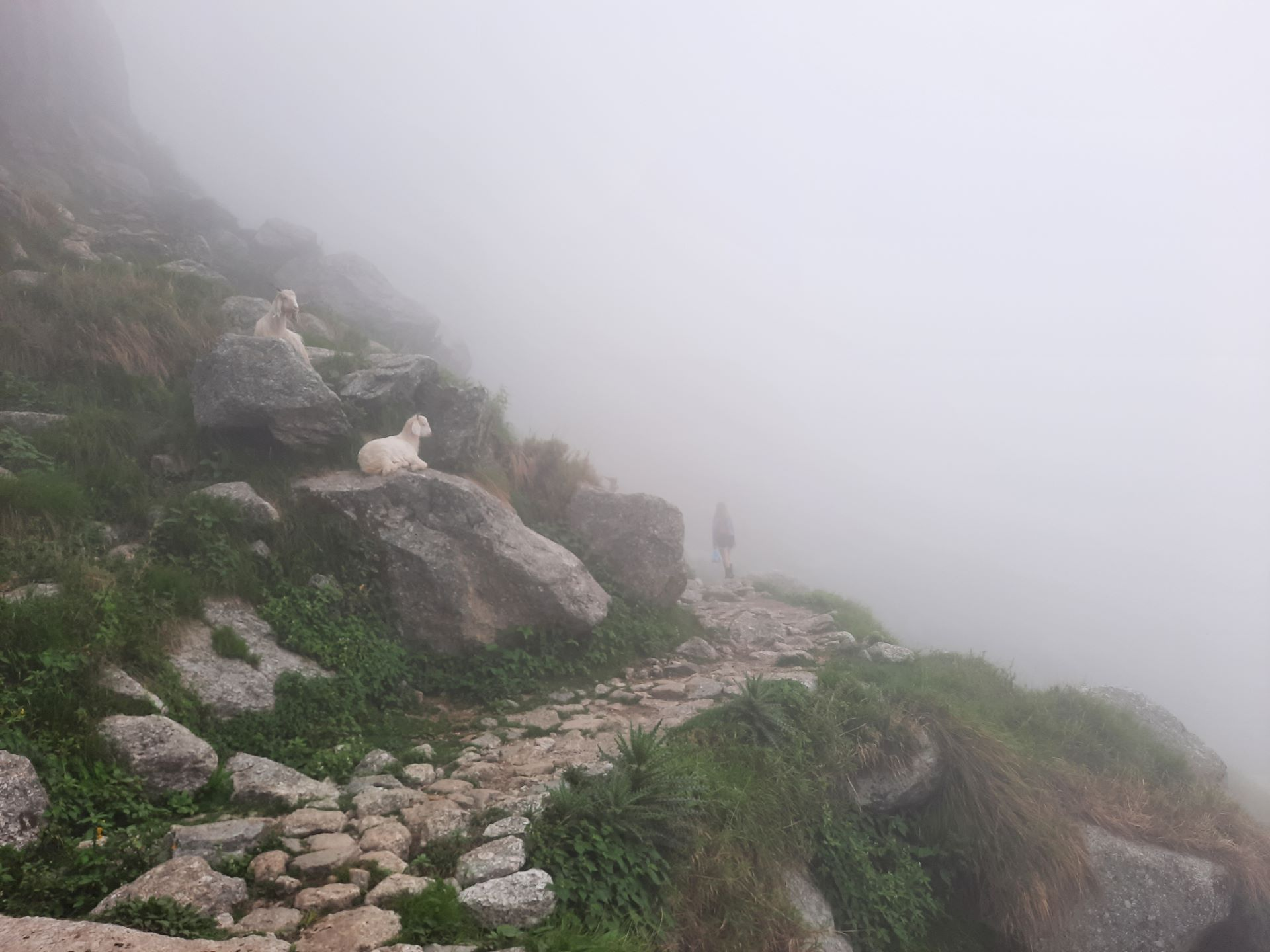
We reached a higher elevation, and mountain goats were blocking our way. We had to wait a few minutes for them to move, but it was a great experience to see them up close against the misty backdrop.

Blue Planet Travellers
Himalayan mountain goats blocking our trail

Blue Planet Travellers
Mountain goats everywhere
By this point, the trail was still ascending, with no descents yet. After about 3 hours of trekking, we were rewarded with a mesmerizing view of the Dhauladhar Mountain Range.
Another half hour of ascent and we reached the top of the Triund Ridge. Just as we arrived, it started raining. Even with the rain, the temperature was around 25°C. We took shelter at the teahouse for a while, bought ponchos, and then decided to explore the area. The rain stopped after about 5 minutes, and we were able to walk around the mountain ridge.

Blue Planet Travellers
At the summit

Blue Planet Travellers
Top of the Triund Hill

Blue Planet Travellers
The view around the summit of Triund
Triund Ridge is a base camp used for acclimatization by trekkers heading to Indrahar Pass. We saw tents set up for trekkers who were resting before continuing their journey.

Blue Planet Travellers
The beautiful view of Dhauladhar mountain ranges on return from the Triund Hill
From this point, several other treks branch out into the Dhauladhar range of the Himalayas. Triund acts as a base camp for many adventurous routes, including several multi-day hikes that lead deeper into the Himalayan region, such as the Seven Lakes of Dhauladhar and a few more trails that explore deeper into the mountains.
The Descent
After spending an hour soaking in the beautiful views of the Himalayan range, we began our descent via the Bhagsu Nag Waterfall route. We walked along a ridge where we could clearly see two mountain peaks. The two peaks were like ridges themselves, with the summit of one seamlessly connecting to the summit of the other. We walked along the ridge to the top of the first peak and then to the top of the second. From this point, We could see the Himalayan valleys stretching deep below us on both sides, to our left and right. About 100 meters further, the ridge connected us to the top of another mountain, and we began our descent from there.

Blue Planet Travellers
Walking the ridge between two Himalayan peaks on our descent

Blue Planet Travellers
Trail along the top of the mountain summit
We all felt that the route down resembled the French Alps, with green meadows and large boulders scattered everywhere.
As we continued down the mountain, we realized that descending was much harder than climbing up. The route had large rocks that required us to jump down at some points.

Blue Planet Travellers
The descent took us through a whole new landscape
We saw people climbing up this route and appreciated both the route we ascended and the one we descended. It’s hard to imagine doing it the other way around because the morning views while climbing via McLeod Ganj – Gallu Devi Temple were so beautiful. If we were to do the trek again, we would likely choose the same route.
After about 8 hours, we reached Bhagsu Nag Waterfalls. Since June falls in the summer and is relatively dry, the waterfall had only a thin flow of water. During the monsoon season, from July to November, the waterfall is much fuller and more spectacular. However, June is one of the best times to do the Triund trek, with comfortable weather and better trail conditions. We took a quick glance at the waterfall and moved on, as we were quite tired by the end of the trek.

Blue Planet Travellers
Bhagsu Nag Waterfalls

Blue Planet Travellers
The mountain stream at the end of the trail

Blue Planet Travellers
Hot Thukpa-noodle soup
From there, it was another 20-minute walk back to McLeod Ganj. We headed straight to have dinner. Tibetan food is quite popular throughout the Himalayan region, so we went out to enjoy some Thukpa, a hot and flavorful Tibetan noodle soup. It was a warm and comforting meal after our trek.
Where to stay
Staying in the Himalayan region is a gift in itself. We preferred to stay in Dharamshala (1,457 metres / 4,780 feet above sea level) because it offers beautiful views of both the valley below and the McLeod Ganj and Dhauladhar mountain ranges. From McLeod Ganj (2,082 meters /6,831 feet above sea level), you mainly get views of the valley below and the mountains surrounding Dharamshala.

Blue Planet Travellers
View of Mc Leod Ganj from our resort – Brij Anayra
There are plenty of hotels and resorts in the area, with options ranging from under $50 per night to much higher-end stays. We came across pictures of Brij Anayra boutique retreat and resort, and the views looked absolutely mesmerizing. Although it was on the higher end of our budget, we decided to splurge on this stay and balance our budget elsewhere, and it was a great choice. The view of the Dhauladhar mountain range from the dining area was simply stunning, nothing like it! When it got dark, watching the lights from the houses in the valley below turn on one by one, giving the valley a starry look, was incredibly relaxing.
The resort itself was beautiful, with sprawling grounds and lush gardens. To make the stay even more special, the resort was adjacent to a tea estate, and we were allowed to walk through the tea fields. Strolling among the tea plants with the mountains in the background was an experience we truly enjoyed.
If you are looking for more affordable options, there are plenty of hotels in Dharamshala and hotels in McLeod Ganj to choose from, with something to suit different preferences and budgets.
Trek and Trail Details
Fee and Registration
For the trek start early morning, there is a fee to the the triund trek. An entry fee of approximately Rs100-Rs200 per person is now charged at a police checkpoint near the Gallu Devi temple. You must register your details at the checkpoint when starting from the Gallu Devi temple side.
Facilities Along the Trail
There are stores along the way if you need some snacks or water juice etc. There are no washrooms anywhere along the trail, so plan accordingly before you start your trek.
Route Recommendation
We recommend going up via the Gallu Devi Temple route and coming down via the Bhagsu Nag Waterfalls route, so you can enjoy the very different views from both routes. The Gallu Devi Temple route is often misty, offering beautiful views of the mist-covered Himalayan mountains. Even though it was misty, it wasn’t cold, the June temperature stayed comfortably between 20°C and 25°C throughout the trail. On the way down via Bhagsu Nag Waterfalls, you’ll get to see the waterfall below and the river winding through the valley.
Tips to Hike Triund
How to Get There
From Delhi take a flight to Kangra airport 1.5 hrs. From Kangra airport take the taxi from Kangra airport to Dharamsala 18.5 km.
Best Time to Visit
March to June and September to November are ideal months for clear skies and comfortable weather. June is the best time to hike the Triund trail. It may rain for a short while, keep a rain poncho handy. Overall, the weather stays around the mid-20s Celsius, making it pleasant for hiking in June.
Start Early
Begin your trek early in the morning to avoid fog and make it back before sunset.
Carry Essentials
Water, snacks, sunscreen, a cap, raincoat, and a light jacket are useful to have. Most of these essentials and snacks are also available at the tea houses along the trail, but they can be spaced quite far apart. So, carry enough for the hike, but keep your backpack light. Wear sturdy trekking shoes with a good grip, as you’ll be walking along mountain edges and uneven terrain most of the trail.
Difficulty
It’s a moderate trek, basic stamina helps you enjoy it comfortably. Although, keep in mind, it’s an 18 – 20 km hike that requires a reasonable level of fitness.
Respect The Himalayas
Avoid littering and be mindful of local wildlife and mountain goats.
Overnight Option
If you’re on a multi-day trek and need accommodation, or simply plan to camp overnight at Triund, book your tent at the top in advance and carry warm layers. We couldn’t find a place to book a tent in advance before starting the trail. If you’ve been to Triund and booked a tent ahead of time, please share where you booked it in the comments below so other hikers can benefit too!
Leave a Reply